


2012-05-25
2012-05-07
Unity Of Mankind - Acharya Dharmadev, VidyaMartand
The Vedas carry the message of universal love and brotherhood in such a forceful and effective way as perhaps no other scripture does. This message has a special significance for the modern age as we all stand divided on the shallow grounds of region, caste, creed, colour, religion etc. All such differences are, however, man-made and totally opposed to the spirit of the vedas.
Such great emphasis is laid on the universal brotherhood and the spirit of unity in the vedas that the words like Sakhaayaha (which means "friends") have been used for ordinary men in relation to each other. Take for instance, the use of these words in the following vedic mantras:—

Unity in Diversity :
The spirit of unity is all pervasive in the Vedas. To drive home this point the renowned vedic scholar, Prof Max Meuller, quoted the following mantras during the course of his address at the World Oriental Conference held in London in 1885:-

O , ye men, walk together, talk together, acquire knowledge and share your duties together !
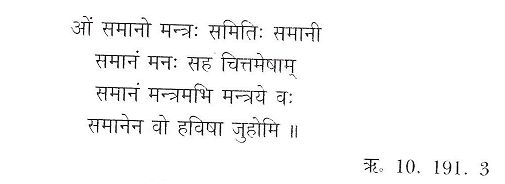
O , ye men, meet together, think together and be of the similar mind !

O, ye men common be your aims and your hearts, being united, beat in one sweet harmony !
Let your thoughts be also one and ye live happily together !
The vedas emphasize that it is our duty not only to love and help others of our own species but also all beings and pray for all including birds, animals, plants and trees.

According to the vedas, the Risi is not one who lives the life of a hermit and is engaged in the observance of different types of austerities and penances or the study of scriptures or meditation but one who is devoted to the common good:

Vedas also describe the man of true knowledge (Jnaani) as one devoted day and night to the welfare of others :—

Overcoming hatred
One of the obstacles that we encounter in extending the circle of our friends is the ingrained feeling of hatred among most of us. ln fact it is Number One killer of universal love and the unity of mankind. Hatred is mostly fuelled by jealousy though there are other reasons for its existence too.
So long as we keep asking ourselves, why has this man got a good job while l have not, why his house or car is bigger than mine, why his children are brighter than mine, why is he on the whole luckier than me, we will not be able to overcome hatred which goes hand in glove with each other.
Hatred also reflects lack of understanding, goodwill, tolerance, kindness, generosity, spirit of sacrifice etc which form the bases for true friendship and love.
Vedas, with their message of universal love, brotherhood and friendship, therefore, repeatedly warn us against hatred and contain several prayers to overcome this vice.
Take for instance, the following mantras from two different vedas:

(As we cross the swift current of a river, may we, through Thy grace, overcome hatred)

(Keep us away Oh God, from the feeling of hatred!)
Dasyu and arya
The mention of the words Dasyu and the Arya in the Vedas has led some misguided critics to see the instance of racialism in these most ancient and sacred scriptures and to raise the question how could they be said to be promoting universal love and brotherhood if they encourage one caste (arya) at the cost of the other(dasyu) ?
First of all let it be clarified at the very outset that dasyu and Arya have nothing to do with any caste.
lt would be travesty of facts to believe in the racialism theory in view of massive evidence against it. Several vedic scholars(both of lndia and abroad),after years of research, have come to the conclusion that to hold the view that the aryas attacked the dasyus (standing for the aborigines Dravadians), is thoroughly disgusting and illogical.
For instance, says the renowned German vedic scholar Prof Max Muller : -
"They (the epithets Aryans and Dasyus) are too general to allow us the inference of any ethnological conclusion"
He is fully supported by another German scholar Prof Roth who clearly points out that "It is but seldom, if at all, that the explanation of Dasyu as referring to the non-Aryans, is advisable "
Says another foreign scholar Nesfield:—
"There is no division of the people as the Aryan conquerors of lndia and the aborigines of the country. That division is modern and that there is essential unity of lndian races, "
Stating that the dasyus were not non- aryans, a reputed Indian vedic scholar asserts that "The theory that the Dasyu— Dravidians inhabited the Punjab and the Ganges valley at the time of the so- called Aryan invasion of India and overcome by the latter they fled to South India and adopted it as their home, can not stand, "
Emphasizing that the words aryas and dasyus are not indicative of different races , Dr. PTS lyangar, a south lndian Scholar says. "The words refer not to race but to cult"
Throwing light on this issue Sri Aurobindo, the founder of the Pondicherry Ashram and the world renowned scholar and a yogi, emphatically says in his book "The Secrets of Vedas " : -
"Far from any reference to any political or military struggle between the invading Aryans and the local inhabitants, is only indicative of the triumph of the forces of light(symbolized by Truth and Knowledge) over the forces of darkness(symbolized by falsehood and ignorance). "
At least one thing is clear from the above expert opinions that the words arya and dasyu in the Vedas do not stand for castes or races and, therefore the allegation of depicting any war among them or encouraging one of them against the other are false and unfounded.
What then do the words arya and dasyu exactly mean in the vedas and what is their significance?
"The word arya has its origin in the root “Ru” which according Sanskrit grammar means”Gati Prapanayou”(the man of knowledge and action who pursues the path of goodness and nobility and also helps others to do so.)"
Taking clue from the above, the Sanskrit lexicons, grammarians and scholars have used the word arya for the person who is ;-

("Respectable, noble, religious, righteous, adorable, generous, peaceful, just, dutiful, generous, etc’”)
Rigveda (10-65-1 l) defines the word arya in the following way :—

(Arya is one who practises on this earth the vows of truth, non-violence, purity, benevolence etc,)
And the word dasyu is born of the root “dasu-UpEkshayE” which means one who, bereft of good qualities, is engaged in destructive activities like putting obstacles in the performance of the yagna.etc. This is why Yaskacharya says:

The adjectives Akarma and Amantuused for dasyu in the following mantra from Rigveda make it clear that he is one who keeps himself engaged in bad actions and is devoid of rational thinking; and who also does not observe the self- imposed discipline pertaining to observance of truth, brahmacharya, non-violence etc. :-

CONCLUSION :
So if there is any praise for the aryas and condemnation of dasyus, it is on the basis of their merit and not their caste or race. The depiction of light between them may also be symbolic of the struggle between the good and the evil within us .

2012-04-23
PATRIOTISM, NATIONALISM AND INTERNATIONALISM
PATRIOTISM, NATIONALISM AND INTERNATIONALISM
(By Acharya P.T. Dharmadev Vidyamartand ji)
What is the difference between patriotism, nationalism and internationalism? What is their respective relevance and what should one opt for and why? What have the vedas to say about this issue'?
Yogi Sri Aurobindo has, in one of his writings made a fine distinction among the above three. According to him, to love the country in which you are born and be prepared to sacrifice everything for it and to channelize all your energy for the uplift of its people, is patriotism.
Nationalism also implies love for the country but with a little difference; that is, in this you are likely to be over-zealous and also aggressive and do not mind protecting and furthering its interests at the expense of others. While pure patriotism is praiseworthy, aggressive nationalism spreads intolerance, falsehood and hatred and may also involve injustice and violence. (Hitler’s aggressive nationalism may be cited as an example).
Commenting on this subject, Sri Aurobindo says in his book Nationalism 1923);
"We have felt its iron grip at the root of our life and for the sake of humanity we must stand up and give warning to all that this nationalism is a cruel epidemic of evil that is sweeping aver the human world of the present age and eating into its moral vitality.”
Internationalism means loving other countries of the world as your own. It also involves working towards the concept of one government which is still the humanity’s dream.
Says Yogi Sri Aurobindo about its "Internationalism is the attempt of the human mind and life to grow out of the national idea and form and even in a way; to destroy it in the interest of the larger synthesis.
‘The unity of the human race can only be secured and can only be made real if the religion of humanity which is at present the highest active ideal of mankind, spiritualizes itself and becomes the general inner law of human life.
"A religion of humanity means the growing realization that there is a secret Spirit, a Divine Reality, in which we are all one, the humanity is its highest present vehicle on earth. By its growth within us, oneness with our fellow men will become the leading principle of all our life; not, merely a principle of cooperation but a deeper brotherhood, a real and an inner sense of unity and equality and common life. "
And here are former President Dr Radha Krishnan’s comments on this subject:
"Interdependence of nations is the supreme factor today and there is no doubt that the world is moving towards the idea of a unified authority. "
The United Nations Organisation was set up with the long-term objective of gradually moving towards the realization of One World Government but even after several years of its formation, it still remains a distant goal. Lack of mutual understanding and trust among the member nations, groupism and conflicting goals may be cited as some of the causes of its virtual failure though it did succeed at times to defuse tension.
As the vedic teachings are based on the principles of peace, justice and universal brotherhood, it is obvious for them to support only patriotism and internationalism and the nationalism (as it is understood and defined in the light of history) is out of their reckoning.
Patriotism and Vedas :
Pure patriotism (as defined by Sri Aurobindo) finds its expression in several mantras in the vedas
Says Atharveda :-

(This Earth is my mother and I am her son).
The word "mother" has also been used for the earth (motherland) in the following vedic mantra:

(I have adopted this earth as my mother; let it also adopt me as her son)

(O Mother, may I never do anything Which may ever hurt or offend thee;)
Obviously if you truly love your country (as you would your mother), you can not do anything which hurts her; i.e., which brings a bad name to her or put her to embarrassment or shame. lt is understood mother cannot cause any harm to her son.
The same spirit of patriotism is reflected in the following prayer in the Yajurveda: (22. l2) which puts before us the concept of an ideal motherland:

( May the Brahmins be full of divine splendor and the kshatriyas of valour true; let them also be skilled in the use of weaponry; let the vaishyas possess cows and buffaloes; and let women be intelligent too! Let there be timely rains and let the herbs get ripe in time! Let everyone tread the path Of progress and prosperity)
It is in the same spirit of patriotism that another prayer is offered to the Motherland herself :—

(In this mantra, Motherland has been invoked for her blessings so that we remain physically fit and healthy, acquire knowledge, consume goods produced indigenously, and be always ready to sacrifice even our lives for her)
What better evidence of patriotism than these genuine and passionate prayers in the vedas for the welfare of all the four varnas of the society and also for the mercy of the Nature, consumption of indigenous goods, physical fitness, cultivation of values like truth, production of wealth including food grains, medicinal herbs, fruits and vegetables in the motherland?
And to such a motherland are offered salutations and our heads bow down to her in awe and reverence :-

lt is repeatedly said in the vedas that the thoughtful, the wise and the knowledgeable persons (who have been described as “Marutaaha swarkaah maryaha stotaaraha and ritwijaha) do their best for their motherland :-

(Through their good deeds let them work for the reputation and honor of their motherland)
Even others (i.e., the ordinary persons) should join them in the service of the motherland.
Says Rigveda :-

(Serve the Motherland with all your heart)
An assurance to dedicate ourselves to the service of the motherland and, if need be, even to sacrifice our lives for it has been given in Atherveda :-

Here is the pledge we are made to take to always speak well of our motherland:

(Wherever l may live - in a village, a forest or a battlefield, let me always speak well of my motherland) - Atharveda 12.1.56)
Preserving of the honor and integrity of our motherland is our first and foremost duty and we should not mind even using force to thwart the evil intentions of the aggressors.
Says Atharveda(12. 1. 14) :-

Internationalism and Vedas :
India with its motto of "VASUDHAIVKUTUMBAKAM" is the pioneer in this respect.
As pointed out earlier, vedas want us to look at all people with a friendly eye and want others also to look at us the same way.

ln another mantra from the Atharveda ( 3.30,50) God says:

(Love each other as two bullocks yoked together and working shoulder to shoulder to achieve common objective. Uttering sweet words to each other, let your hearts be united.")
Krinvanto Vishwam Aryam : Make the whole World Noble.
2012-04-18
2012-04-12
How nutritious is the egg? - A. Srinivasa Murthy
NUTRITION - Recent studies challenge the popular belief that eggs are highly nutritious - A case against the consumption of eggs.
Is egg vegetarian or non-vegetarian is not a question more important than whether it is good or bad.Let us dwell upon this latter question, obviously to address ourselves to former.
The egg consumption in India during 1950s was about five million. In 1996 it is about 10 billion according to official ` statistics. What caused this phenomenal increase in egg consumption (36 per cent) in a society which is predominantly vegetarian?
The ’credit’ must undoubtedly go to the sustained high pressure advertisements in the media through the patronage of National Egg Co-ordination Committee, the apex body of poultry business.
Almost all the leading periodicals, magazines (except, of course science journals) both in English and vernacular languages have come out with colorful advertisements extolling the ’quality’ of eggs as the ’multi-vitamin capsule', "mummy’s best choice for the computer conscious child" etc.,
(In fact, there is no direct relationship between a particular food stuff and a particular body function). The propaganda has to a great brain-washed consumers to believe that egg is the best food now available.
(In fact, there is no direct relationship between a particular food stuff and a particular body function). The propaganda has to a great brain-washed consumers to believe that egg is the best food now available.
Let us now examine, with the help of recent findings/ studies in the field of medicine and nutritional science, how much substance is there in these advertisements.
A typical advertisement on egg in any leading magazine says that it is very nutritious, rich in minerals, vitamins and protein, that it is a multivitamin capsule containing Vitamin ’A’, ’B’ and 'D’ and all that. This claim is a half-truth and is distorted also.
The fact is that egg can be taken mainly as a source of protein and not of vitamins. But the advertisement creates an impression that egg contains all nutrients that a human body needs, irrespective of age. In nature no single item of food contains all the nutrients. It must be gathered with wide variety of food stuffs which include carbohydrate sources, protein sources and some vitamin & mineral sources. So a judicious combination is a palatable balanced food.
Coming to the nutritional value of egg, it contains per 100 gms. wt. about 13.6 percent of protein, 13.3 per cent of saturated fat as against any dhal (pulses) traditionally used m Indian household, which contains 24 percent of protein, 1.3 per cent of unsaturated fat etc. Egg cannot be considered as a main source of protein which is essential for growth.
Secondly the claim about eggs as a vitamin source is also false and the functional role of vitamins mentioned in the advertisement is also similarly wrong and misleading. An egg contains about 1200 LU. of vitamin ’A’ as against 8,000 to 10,000 I.U. in drumstick leaves and 10,000 to 12,000 l.U. in coriander leaves which are not only cheap but contain other nutrients also. Vitamin A is sufficiently available in all leafy vegetables and carrots in the pure natural form known as beta carotene.
About Vitamin ’D’, the claim in the advertisement is again misleading. Vitamin 'D’ is normally manufactured by the fat in our body under the skin with the help of sunlight, which is so abundant(Thanks to Surya Deva) in our country. There is no necessity of gulping this vitamin through food on payment.
The advertisement on egg is again false about Vitamin ‘B’ which is an essential water soluble substance required for nervous system to sustain. This Vitamin is a complex group consisting of Vitamin ‘B’ to Vitamin B6-B12 which are normally found in cereals and certain vegetables. This complex vitamin is found in Egg only in microscopic traces and the proportionis to be treated as nil.
Fermented food like dosa and idly provide ample Vitamin B group - An egg now costing around 3-5 rupee is much costlier than pulses and vegetables for the quantity of nutrients available and hence commercially not viable and not preferable to harmless alternative in pulses free from saturated fat and cholesterol.
What is strikingly significant in the advertisement (normal food stuffs do not require any advertisement) about the egg is the complete and deliberate suppression of facts that classify egg as a very harmful food stuff.
Each egg weighing about 100 gms contains about 450 to 500 mg of cholesterol, a dangerously large quantity, a substance conclusively proved as responsible for heart attacks, strokes and other cardiovascular diseases (for comparison : the Quantity of cholesterol in one cup of milk is 5 mg/ 100 mg., in meat around 125 mg. and in brain & lever around 1000 mg).
According to a number of studies conducted recently, consumption of each egg adds about 5 mg of cholesterol into the blood.
It is medically established that cholesterol in excess of 250 mg. in our system will predispose cardiovascular disease leading to heart attacks and strokes. Thus regular consumption of egg as recommended in the advertisement is fraught with danger and will certainly be detrimental to one’s health. As a matter of fact egg is to be completely excluded from the diet of middle aged and elderly people.
lt is not just this. The saturated fat in egg in large quantity, almost equal to that of its protein will provide a strong base for the cholesterol to deposit in the arteries. One of the most valuable discovery is the role of an amino acid called methlonine in promoting heart disease and which destroys Vitamin in our body. This is found in egg like meat.
These vitamins are fat soluble and hence in excess. If consumed, these are not removed from the body but retained to cause many harmful side effects. Excess consumption of Vitamin D (this becomes excess if consumed through food regularly as it is manufactured in the body by the incidence of sunlight) will cause kidney and bladder stones by crystallizing calcium which becomes again excess due to milk consumption and interaction with uric acid. However, consumption of Vitamin A in its pure form through leafy vegetables becomes limited to the body’s needs due to its bulk.
Again, each egg has about 25,000 to 30,000 micropores on its outer shell for oxygen transportation to the embryo. This serves as inlets to the microbes that contaminate it if stored in open at a temperature above 30 degrees. So, egg becomes unfit for consumption within 48 hours of storage if not stored in the refrigerators. We know how egg is now being stored and sold in our cities and towns.
There is yet another important observation about egg which makes it unsuitable for regular consumption. That is about its carbohydrate and fiber factors. Carbohydrate is the fuel in food and it is essential to any staple food to produce energy. Since egg does not contain carbohydrate and hence does not contribute to produce enough calorific value for sustenance and stamina as compared to cereals and pulses. (100 gms of ground nuts = 549 calories, 1 egg = 170 calories.)
Besides all these inherent drawbacks and defects that brands egg as a harmful food, there are many more dangerous aspects involved in its mass production due to factory farming of poultry birds.
In almost all modern poultry farms employing broillers, hens are given large quantities of antibiotics, harmones and tranquillisers in their feed to ward off animal diseases which are easily transmitted to humans and to make the birds lay more eggs, to increase their weight and to prevent them from fighting when stacked in a congested enclosures of artificial lighting.
Particularly the antibiotic gentamycin which is widely used in poultry feed is transmitted in traces into the egg is known to damage kidnet filters. It is established that gentamycin is a branded nephrotoxin ,that damage our kidneys.
Acknowledgement :
Article Courtesy : Deccan Herald - 23/3/1996
2012-03-31
Equality In Vedas - B.V. Yathiraj
The Vedas teach equality among the people in society. No one is superior or no one is inferior. We find Samaanatha in the Vedas.
Rigveda says : -
"Te ajyesthaa akanisthaasa udbhido amadhyamaaso mahasaa vi vavridhuh | sujaataaso janushaa prishnimataro divo marya aa no achaa jigatana ||" - Rig: 5-59-6
Among these men there are no superiors or no inferiors, no middle ones either. They become great from small beginnings. They make progress in different ways by dint of their merits. By birth they are all highborn because they are all children of Mother-Earth. O you men of the Lord Refulgent! be available to us in a loveable manner or grow into praise-worthy souls in fair ways.
“Ajyesthaaso akanislliaasa ete sam bhraataro vaavridhuh saubhagaaya|yuva pita swapaa rudra eshaam sudhughaa prishnih sudinaa marudbhayah||“ - Rig : 5-60-5
These men are without superiors and without inferiors. They are mutually brothers. They march onwards for prosperity. The eternally youthful, the soul protecting, grief alleviating God is their father. The richly feeding Mother-Earth produces happy days to these mortals.
“ Sam samidyuvase vrishannagne visvaanyaarya aa | Ilaspade samidhyase sa no vasoonyaa bhara || “ - Rig: 10-191-1
Oh Almighty and Adorable God ! In the whole universe Thou dost the work of harmonizing and uniting, and most fully reveal Thyself in the world. We therefore, beseech Thee to bestow upon us in every way all the means that will enable us to live in peace and harmony.
“ Sam gacchadhavam sam vadadhvam sam vo manaamsi jaanataam IDevaa bhaagam yathaa poorve sam jaanaanaa upaasate II “ - Rig: 10-191-2
God says :- Let all your activities be so directed as to lead you to one common goal (for which) let there be conferences held among you in a common language. Let all of your minds be one for according to acquire knowledge of the various lore’s. In short do as the enlightened before you in all ages did, performing their tasks in life in cooperation and harmony, with minds in full agreement for the acquisition of knowledge. Like the ancient seers also, Worship alone, Who, the only real object of your devotion.
“Samaanee va aakootih samaanaa hridayaani vah |
Samaanam astu vo mano yathaa vah su sahaasati II “ - Rig: 10-191-4
Let your object in life be one and the same, your hearts equal (in feeling) and your minds in full agreement so that an excellent common status of life be achieved for all.
The following Atharveda mantras also give a candid proof about the equality : -
The following Atharveda mantras also give a candid proof about the equality : -
“Sahridayam saamanasyam avidvisham krinomi vah I
Anyo anyam abhi haryata vatsam jaatamivaaghnyaa || “ - Atharva : 3-30-1
Oh men ! I ordain for your concord of heart, unanimity of mind and freedom from hatred in dealings with each other. Love one another in every way even as the inviolable her new-born calf.
“Samaanee prapaa sahavoanna bhagaha samaane yoktre saha vo yunajmi |samyanchognim saparyataaraa naabhimivaabhitah ||” - Atharva : 3-30-6
O you men! may your water reservoirs be common; may the shares of food be enjoyed jointly. I unite you all under the yoke of common code of conduct with one another. Worship the Lord of Lustre congregationally, just as the spokes touch the hub from all sides.
“Sadhreecheenaanvah sammanasaskrinomyekasnushteentsamvananena sarvaan I
Devaa ivaamritam rakshamaanaah saayam praatah soumanaso vo astu ||” - Atharva : 3-30-7
Devaa ivaamritam rakshamaanaah saayam praatah soumanaso vo astu ||” - Atharva : 3-30-7
I enjoin on all of you to be mutually helping one another, to be united in your mind and to have one goal in life. You should, like the wise of all ages, ever cherish the idea of the liberation of your souls from the trammels of the world and to this end may peace of mind increase among you evening and morning.
“Samaano mantrah samithih samaanee samanam vratam sahachithameshaam|
samaanena vo havishaa juhomi samaanam cheto abhisamvishadhvam ||”-Atharva : 6-64-2
samaanena vo havishaa juhomi samaanam cheto abhisamvishadhvam ||”-Atharva : 6-64-2
May your thoughts and hymns be common; may your assembly be common; may your austere vow, spiritual resolve be common; may all your minds be alike and united. I provide you with common food, drink and needs of life. All of you strive for a common objective.
“Sam vah prichyantaam tanvah sam manaamsi samuvrataa I
Sam voyam brahmanaspatirbhagah sam vo ajeegamat II “ - Atharva 6-74-1
Sam voyam brahmanaspatirbhagah sam vo ajeegamat II “ - Atharva 6-74-1
Let your bodies (or learning and other attainments) and minds work together in harmony for the achievement of the common ideal. It is for this that the Majestic God, the Protector of the universe, has brought you together in life.
“Sam jnapanam vo manasotho samjnapanam hridah |
Atho bhagasya yachchraantam tena samjnpayaami vah ||” - Atharva 6-74-2
Atho bhagasya yachchraantam tena samjnpayaami vah ||” - Atharva 6-74-2
Let your heads (minds) work in calm and precision and let your hearts join them in contented co-operation. In addition to this for the trouble you have taken to realize the majesty of God, I invigorate you (that you proceed on and reach your goal.)
2012-03-28
ಮರಣವೆಂದರೆ ಭಯವೇಕೆ ? - ವಿದ್ವಾನ್ ಕೆ. ಜಿ. ಸುಬ್ರಾಯ ಶರ್ಮಾ
ಈಗಿನ ಕಾಲದ ಮಾನವನು ಯಾವುದಕ್ಕೂ ಹೆದರುವುದಿಲ್ಲ. ಏಕೆಂದರೆ ಹಣದ ಬಲದಿಂದ, ಅಧಿಕಾರದ ಬಲದಿಂದ,ತನ್ನ ಬುದ್ಧಿಶಕ್ತಿಯ ಬಲದಿಂದ ತಾನು ಏನು ಬೇಕಾದರೂ ಮಾಡಬಲ್ಲೆ ಎಂದು ತಿಳಿದಿದ್ದಾನೆ.ಇದು ಸತ್ಯವೂ ಹೌದು.
ಆದರೆ ಒಂದು ವಿಷಯದಲ್ಲಿ ಮಾತ್ರ ಎಂಥವನೂ ಭಯಪಡುತ್ತಾನೆ. ಅದೇ ಮರಣದ ಭಯ. ಮರಣವನ್ನು ತಪ್ಪಿಸಿಕೊಳ್ಳುವುದಕ್ಕಾಗಿ ಈ ಮಾನವನು ಬೇಕಾದುದೆಲ್ಲವನ್ನೂ ಮಾಡುತ್ತಾನೆ. ಆದರೆ ಏನೇ ಮಾಡಿದರೂ ಒಂದಲ್ಲ ಒಂದು ದಿನ ಸಾಯಲೇಬೇಕು. (“ಜಾತಸ್ಯ ಮರಣಂ ಧ್ರುವಂ“.)
ಸರಿ , ಏಕೆ ಜನರು ಮರಣಕ್ಕೆ ಅಂಜುತ್ತಾರೆ ? ಎಷ್ಟು ಮುದಿಯಾಗಿದ್ದರೂ ಇನ್ನೂ ಸ್ವಲ್ಪ ಕಾಲ ಬದುಕಬೇಕೆಂದು ಬಯಸುತ್ತಾರೆ . ಈ ಸಾವಿನ ಪ್ರಶ್ನೆಗೆ ಋಷಿಗಳ ಉತ್ತರ --
“ಪ್ರಾಯೇಣಕೃತಕೃತ್ಯತ್ವಾತ್ ಮೃತ್ಯೋರುದ್ವಿಜತೇ ಜನಃ |
“ಪ್ರಾಯೇಣಕೃತಕೃತ್ಯತ್ವಾತ್ ಮೃತ್ಯೋರುದ್ವಿಜತೇ ಜನಃ |
ಕೃತಕೃತ್ಯಾಃಪ್ರತೀಕ್ಷಂತೇ ಮೃತ್ಯುಂ ಪ್ರಿಯಮಿವಾತಿಥಿಂ || “
ಅಕೃತ್ಯಕೃತ್ಯರಾಗಿರುವುದರಿಂದಲೇ ಪ್ರಾಯಶಃ ಜನರು ಮರನವೆಂದರೆ ಗಾಬರಿಪಡುತ್ತಾರೆ. ಆದರೆ, ಕೃತಕೃತ್ಯರಾದ ಧೀರರಾದರೋ, ಸಂತೋಷದಿಂದ ಅತಿಥಿಯನ್ನು ನಿರೀಕ್ಷಿಸುವಂತೆ ಮರಣವನ್ನು ಸ್ವಾಗತಿಸುತ್ತಾರೆ. ಅವರು ಮರಣಕ್ಕೆ ಅಂಜುವುದಿಲ್ಲ.
ಎಷ್ಟೇ ವಯಸ್ಸಾಗಿದ್ದರೂ, ಸಂಕಟದಲ್ಲಿದ್ದರೂ, ದುಃಖದಲ್ಲಿದ್ದರೂ ಏಕೆ ಬದುಕಲು ಬಯಸುತ್ತಾರೆಂದರೆ , ಅವರ ಮನಸ್ಸಿನಲ್ಲಿ ಕರ್ತವ್ಯ ಬುದ್ಧಿಯು ತುಂಬಿರುತ್ತದೆ. “ನಾನು ಕೃತಕೃತ್ಯನಾಗಿದ್ದೇನೆ , ನಾನು ಕೃತಾರ್ಥನಾಗಿದ್ದೇನೆ” – ಎಂದು ತಿಳಿದವನಿಗೆ ಮರಣದ ಭಯವುಂಟೇ?
ಭಯಪಟ್ಟಮಾತ್ರಕ್ಕೆ ಮೃತ್ಯುವು ಅವನನ್ನು ಬಿಟ್ಟುಬಿಡುವನೇ? ಖಂಡಿತಾ ಇಲ್ಲ! ಹಾಗಾದರೆ ಮೃತ್ಯುವು ನಮ್ಮ ಬಳಿಗೆ ಬಾರದಂತೆ ಮಾಡಿಕೊಳ್ಳಲು ನಾವುಗಳು ಏನು ಮಾಡಬೇಕೆಂದರೆ -
“ ಮ್ರುತ್ಯೋರ್ಣಭೇಷಿ ಕಿಂ ಮೂಢ ? ಜಾತಂ ಮುಂಚತಿ ಕಿಂ ಯಮಃ ?
ಅಜಾತಂ ನೈವ ಗೃಹ್ಣಾತಿ ಕುರು ಯತ್ನಂ ಅಜನ್ಮನಿ || “
ರೇ ಮೂಢ , ಮರಣವೆಂದರೆ ಯಾಕೆ ಹೆದರುತ್ತೀಯೋ? ಹುಟ್ಟಿದ ಯಾರನ್ನೇ ಆಗಲಿ ಮೃತ್ಯುವು ಬಿಡುತ್ತಾನೆಯೇ ? ಹುಟ್ಟದಿರುವವನ್ನನ್ನು ಮೃತ್ಯುವು ಮುಟ್ಟುವುದೇ ಇಲ್ಲ. ಆದ್ದರಿಂದ ಪುನಃ ಹುಟ್ಟದಂತೆ ನಿನ್ನನ್ನು ಮಾಡಿಕೋ. ಜನ್ಮರಹಿತನಾದ ಆತ್ಮನೇ ತಾನೆಂದು ತಿಳಿದಾಗ ಅವನಿಗೆ ಮರಣವು ಎಲ್ಲಿದೆ ? ಇಂತಹ ಅಜನಾದ ಆತ್ಮನನ್ನು ತಿಳಿದು ನಾವು ಮರಣದ ಭಯವನ್ನು ಗೆಲ್ಲೋಣವೇ ?
2012-03-17
2012-03-11
2012-02-06
CHATUR-VARNA : THE FOUR CHOICES OF SERVICE
On account of the impressions and influences which the Soul carry with them from life to life, each individual soul has its own tastes and inclinations, talents and capacities. Even a child knows that no two individuals are alike or equal to each other in every aspect. The difference in inclinations and capacities are fundamental, and as such they cannot be erased totally by applying any external pressures. The manufacturers of automobiles may be able to manufacture a few thousand vehicles of same shape, size, colour and power. But, it is not possible for even the most efficient, widely read, profoundly learned and scientifically advanced teacher to train two of his students to be equal to each other in every respect; and there is no wonder about it. Insentient things can be molded entirely to our likings but sentient and scient beings, that we human are cannot be shaped wholly according to our ideas and ideals. So, Wisdom lies in recognizing these innate differences in the individuals and trying to help them to develop their personalities(in a constructive way) according to their own tastes and capacities.
The Vedas speak quite unequivocally about these inborn differences :lÉÉlÉÉlÉÇ uÉÉ E lÉÉã ÍkÉrÉÉã ÌuÉ uÉëiÉÉÌlÉ eÉlÉÉlÉÉqÉç |
iɤÉÉ ËU¹Ç ÂiÉÇ ÍpÉwÉMçü oÉë¼É xÉÑluÉliÉÍqÉcNûiÉÏlSìÉrÉãlSìÉã mÉËU x§ÉuÉ || (HMçü 9.112.1)
Naanaanam vaa u no dhiyO vi vrataani janaanam |
Taksha rishtam bhisak brahma sunvantamicchanthindrayendo pari srava || (Rig 9.112.1)
(Naah dihyah) Our intellectual capacities, (naanaanam u) are indeed diverse and different, (vrataani) spiritual resolves and austeries too, (janaanaam) of the people, (vi) are various and divergent, (taksha) among us the carpenter, (icchati) likes to have, (rishtam) a saw, (bhisak) the doctor, (rutam) an ailing person and (brahmaa) the one well versed in Vedas, (sunvantam) a performer of a sacrifice, (indo) O Supreme moistener, (parisrava) shower thy mercy, (indraaya) for the sake of the soul endowed with perceptive faculties.
Recognizing these natural differences, the Vedas describe four spheres of activities and provide each individual with the scope to develop himself or herself according to his/her choice. Each sphere of activity based on the solid ground of individual choice, is styled VARNA. The Varnas are 4 in number and they are termed
1> Brahmana or Intellectual.
2> Kshatriya or Martial.
3> Vaishya or Commercial.
4> Shudra or Manual.
These varnas are not invariably based on birth; and as such , they cannot be equated with the present day castes which run into thousands. The Varnas are scientific and rational divisions of mankind, aimed at progress of the individual as well as of the society, but the present day caste system is a bane on whole humanity, as it is based on birth of individuals, creating a lot of heart-burn and blood with its notions of superiority and inferiority. Though the present day caste system is remotely related to Vedic Varna Vyavastha, it is wrong to give a bad name to the latter, for, when ignorance, inertia and selfishness gain an upper hand , even the best principle can be reduced to a scourge. Even in case of some religions which was started for good of humanity, we can find that now they have become a centre of all demonic ideologies. Has not God been made an instrument for spilling precious human blood? Has not religion been defaced and reduced to a demonic terrorism force. Can any person turn against God or Dharma on that account? Varnas are natural and rational divisions that promote the cause of human welfare.
According to the varna-system , all the activities or professions that human being can possibly adopt are broadly divided into 4 classes; and each individual is at liberty to choose any one of them and belong to it, ofcourse bearing in mind, his/her own inclinations and capacities. Birth in a particular prevailing varna may be helpful to some extent in making one’s choice, but it is neither necessary nor inevitable for a Brahmin’s son to be a Brahmin or a kshatriya’s son be a kshatriya. A lawyer son may or may not be a lawyer. It is not necessary that a doctor’s son should invariably become a doctor. The fundamental basis of varna system, according to the Vedas is the merit, profession and the nature of each individual(Its not based on birth at all). Birth in a particular family supposed to belong to a varna may cast its influence and may also help to impede, to an extent, the individual to make his or her choice. But it is of secondary importance.
Let us see what Vedas have to say on this subject. In Yajur Veda , we read the following mantra : -
oÉëɼhÉÉãÅxrÉ qÉÑZÉqÉÉxÉÏSè oÉÉWÕû UÉeÉlrÉ: M×üiÉ: |
Fà iÉSxrÉ rɲæzrÉ: mÉ°rÉÉÇ zÉÔSìÉã AeÉÉrÉiÉ ||
(ÄrÉeÉÑ 31.11)
Bṝahmanosya mukhamaasidbaahu raajanyah krtah |
Uru tadasya yadvaishyaha padbhyam shudro ajaayata||
(Brahmanaha) Brahmin, (aaseed) was , (asya mukham) its face, (rajanyaha) kshatriya, (krutaha) was made,(bahu) its arms, (tad) he (yat vaishyaha) who is vaishya (asya uru) was its thighs, (padbhyaam) for sake of, or , in the place of the feet, (ajaayata) was there, (sudro) the shudra.
The traditional interpretation of this mantra as presented by scholars of pouranic thought, is this : “Brahmin came out of Brahma’s mouth, the kshatriya was born from the arms of brahma, the Vaishya came from his thighs and the shoodra from his feet”. It is extremely ridiculous and totally incredible; for nowhere in the whole sukta does this four faced brahma appear. Instead of it, in literal sense, we see there in a purusha, a gigantic person with a thousand heads, thousand eyes and a thousand feet. There is no reference to his arms. Infact, that is not the description of any corporeal being at all. It is a figure of speech, we may say a personification, in which omniscient, omnipercipient and omni-present God, though absolutely formless, is personified. He created the world (“tato viraadajaayata” – Yaju 31-5). Then it is said again figuratively, that whole virat i.e , the whole creation was He, He being immanent. Thus “Virat Purusha” , the “universal person” was conceived. Thereafter with reference to this universal person, we find these questions :-
qÉÑZÉÇ ÌMüqÉxrÉÉxÉÏiÉç ÌMÇü oÉÉWÒû ÌMüqÉÔÃ mÉÉSÉuÉÑcrÉãiÉã | (ÄrÉeÉÑ 31.10.)
mukham kimaasyaaseet kim baahu kimuru paadaavuchyete ? | (Yaju 31.10)
(Kim) what, (aaseet asya mukham) was the face of the universal person? (kim baahu) what were the arms? (kim) what again, (vuchyete) are said to be, (uru paada) the thighs and feet? In answer to these questions , the mantra “oÉëɼhÉÉãÅxrÉ qÉÑZÉqÉÉxÉÏSè oÉÉWÕû UÉeÉlrÉ: M×üiÉ: | Fà iÉSxrÉ rɲæzrÉ: mÉ°rÉÉÇ zÉÔSìÉã AeÉÉrÉiÉ || “ appears. And what a fine metaphor. Is the pouranic interpretation any answer to these questions? Definitely not ! Though the word “Viraat” literally means “universe”, it should be taken to mean “human world” or “human society” as only mankind is in need of service of the intellectual, martial, mercantile and manual classes, and not the sub-human and insentient world. Secondly, all the message of the Vedas are addressed to mankind and not other living being, who have to achieve welfare only through mankind. Thus by reviewing the above verses in light of Vedas the whole thing is clear as day light.
He who carries out in society the functions performed by the face in body of an individual is a Brahmin. All the organs of perception the visual, the olfactory, the palatal, the auditory and the tactile are located in the head. Collecting knowledge and communicating it to the soul is the function of head. It is precisely this function that a Brahmin does in society.
He who fulfills in society the functions carried on in the body of an individual by the arms is a kshatriya. The arms are the administrative as well as the protective organs of the body. It is precisely this thing that a kshatriya does in society; He rules and protects.
What are the functions of the body central? The thighs represent the central part of the body. The Atharva Veda clarifies the point further :-
oÉëɼhÉÉãÅxrÉ qÉÑZÉqÉÉxÉÏ°ÉWÕû UÉeÉlrÉÉãÅpÉuÉiÉç |
qÉkrÉÇ iÉSxrÉ rÉSè uÉæzrÉ: mÉ°rÉÉÇ zÉÔSìÉã AeÉÉrÉiÉÉ || (AÉjÉuÉï 19.6.6)
Braahmanosya mukhamaasidbaahu raajanyo abhavat |
Madhyam tadasya yad vaishyaha padbhyaam shudro ajaayata || (Atharva 19.6.6)
(Brahmanaha) Brahmin, (aaseed asya mukham) was his face, (raajanyaha) Kshatriya, (abhavat asya baahu) was his arms, (tat)He, (yat vaishyaha) who is vaishya,(asya madhyam) was the central part of his body,(padbhyaam) for the function of the feet, (ajaayata)was, (shudraha) the Shoodra.
In the central part of the body, from neck downwards are situated the heart, the lung, the stomach, the alimentary canal, the organs of procreation – in short all important organs that keep the body alive and help its development. These organs jointly produce energy and distribute it to all the parts of the body from the top of the head to the tip of the toes. He who does the same thing in society i.e who produces wealth and utilizes for the benefit of the society is a vaishya. In the very nature of things, vaishyas are in a majority, so much so in the Vedas, the vit means vaishya is used to signify praja or subjects as in “tvaamvisho vrinataama raajyaaya(Atharva 3.4.2) i.e let vaishyas elect you to rule over the land. Let there be no mistake about it. It is not as though the ruler has to rule only over the vaishyas. It is only to be understood that because of their preponderance among the subjects, the word vit has been used as a synonym for the word praja.
And, just as legs, carry it to the desired place, lower limbs, or say the feet uphold the whole body, He who carries the whole weight of the society is a Shoodra. No question of looking him down as sub-human or a slave arises at all.
If one gives a little more attention he can feel the beauty and perceive the significance of this analogy. Suppose a thorn pricks the foot- the shoodra, it is the head , the Brahmin that sighs in grief first, It is the arm, the Kshatriya who hurries to remove the thorn through the thighs , the vaishyas moved accordingly to help the arm to remove the thorn. Thus in a society all these 4 varnas are inter-related and inter-linked. There is no question of superiority and inferiority among them. Each varna is equally great and useful in the spheres of their activity for the common good off the society.
The Vedas strike at the very root of the sense of superiority and inferiority.
The Rig Veda says :-
AerÉã¹ÉxÉÉã AMüÌlɹÉxÉ LiÉå xÉÇ pÉëÉiÉUÉã uÉÉuÉ×kÉÑ: xÉÉæpÉaÉÉrÉ |
rÉÑuÉÉ ÌmÉiÉÉ xuÉmÉÉ ÂSì LwÉÉÇ xÉÑSÒbÉÉ mÉ×ÎzlÉ: xÉÑÌSlÉÉ qÉ°rÉ: || (GMçü 5.60.5)
ajyeshtaso akanishtasa yete sam bhrataro vaavrdhuh saubhagaaya |
yuvaa pitaa swaapaa rudra eshaam sudughaa prushnihi sudinaa marudbhyaha || (Rig 5.60.5)
(Ete) These men , (ajyeshtasaha) are without superiors, (akanishtasaha) without inferiors, (bhraataraha) they are mutual brothers, (vaavrudhuh) they march onwards, (saubhagaaya) for prosperity, (yuvaa) the eternally youthful, (svapaa) the soul protecting, (rudraha) grief alleviating God, (yeshaam pitaa) is their father, (sudughaa) the richly feeding, (prushnihi) mother earth, (sudinaa) produces happy days, (marudbhyaha) for these mortals.
Again,
iÉå AerÉã¹É AMüÌlɹÉxÉ EΰSÉåÅqÉkrÉqÉÉxÉÉã qÉWûxÉÉ ÌuÉ uÉÉuÉ×kÉÑ: |
xÉÑeÉÉiÉÉxÉÉã eÉlÉÑwÉÉ mÉ×ÎzlÉqÉÉiÉUÉã ÌSuÉÉã qÉrÉÉï AÉ lÉÉã AcNûÉ ÎeÉaÉÉiÉlÉ || (GMçü 5.59.6)
Te ajyeshtaa akanishtaasa udbhido amadhyamaaso mahasaa vi vavrdhuhu |
Sujaataso janushaa prusnimaataro divo maryaa aa no acchaa jigaatana || (Rig 5.59.6)
(Te) among these men, (ajyeshtaha) there are no superiors, (akanishtasaha) no inferiors, (amadhyamaash) no middle ones either, (udbhidaha)they become great from smaller beginnings, (vi vaavrudhuhu) they make progress in different ways , (mahasaa) by dint of their merits ;; (janusaa) by birth, (sujaatasaha)they are all high born, because (prusnimaataraha) they are all children of mother earth, (divaha maryaaha) o ye, men of lord refulgent! (aa jigatana) be available to us, (acchaa) in a loveable manner or, (aa jigaatana) grow into praise worthy souls, (acchaa) in fairways.
No one can deal a death blow to the feelings of superiority and inferiority more effectively than the Vedas. People of all varnas are equal in the eyes of God and his revealation, the Vedas. Here is an incontrovertible proof of it :-

xÉqÉÉlÉÉã qÉl§É: xÉÍqÉÌiÉ xÉqÉÉlÉÏ xÉqÉÉlÉÇ uÉëiÉÇ xÉWû ÍcɨÉqÉåwÉÉqÉç |
xÉqÉÉlÉålÉ uÉÉã WûÌuÉwÉÉ eÉÑWûÉãÍqÉ xÉqÉÉlÉÇ cÉåiÉÉã AÍpÉxÉÇÌuÉzÉkuÉqÉç || (AjÉuÉï 6.64.2)
Samaano mantaha samiti samaanee samaanam vratam saha chittamesham |
Samaanena vo havishaa juhomi samaanam ceto abhisamvishadhvam || (Atharva 6.64.2)
(Mantraha) may our thoughts and hymns, (samaanaha) be common, (samitihi) may your assembly, (samaani) be common, (vratam) may you austere vow, spiritual resolve, (samaanam) be common, (chittam)may the mind, (esham) of you all, (saha vah)be alike and united, (juhomi vaha) I provide you all, (samaanena havisha) with common food and other needs of life, (abhi sam vishadvam) enter from all sides, merge entirely in, (samaanam cetah) the common consciousness.
A message of equality cannot be more candid, more appealing than that of the message of Vedas. One may be a Brahmin, a kshatriya, a vaishya or a shoodra;that makes no difference. They are all equal and enjoy equal rights, besides commanding equal respect. There is no doubt, ample room for criminal, heinous and bewildering inequality in the caste system; but the varnas are definitely not castes. Whereas castes are supposedly inherited; varnas are invariably acquired by choice. While castes are believed to be based on birth, which is a pure chance; varnas are rationally based on merit, profession and inclination of the individual.
According to traditional belief , inter-caste dining and inter-caste marriages are taboo; but varna begins a matter of one’s own choice, of course, with the scientific basis of the cardinal factors as explained above. Thus the question of inter varna marriages does not arise at all. With the object of maintaining complete harmony, mutual attraction and undivided devotion to each other in married life, a man and a woman of like merits professions and inclinations must get married; whether they hail from the same caste or different ones is immaterial. From this stand point, “inter-caste marriage” is a misnomer, because, a man marries only a woman and they both are human beings(by birth). They belong to the same caste, we mean human species. If a man were to marry an animal or a bird, there would be something in it to deserve the name ‘inter-caste-marriage’ and inter-dining is no problem at all, again, in the varna system.
xÉqÉÉlÉÏ mÉëmÉÉ xÉWû uÉÉãųÉpÉÉaÉ: xÉqÉÉlÉå rÉÉãY§Éå xÉWû uÉÉã rÉÑlÉÎeqÉ |
xÉqrÉgcÉÉãÅÎalÉÇ xÉmÉrÉïiÉÉUÉ lÉÉÍpÉÍqÉuÉÉÍpÉiÉ: || (AjÉuÉï 3.30.6)
samaani prapaa saha vo annabhaagaha samaane yoktre saha vo yunajmi |
samyanco agnim saparyataaraa naabhimivaabhitaha || (Atharva 3.30.6)
O you men,(vaha prapaa) may your water reservoirs, (samaani) be common, (annabhaagaha) may the shares of food, (saha) be enjoyed jointly, congregationally, (yunajmi) I unite, (vaha) you all, (samaane yoktre) under the yoke of a common code of conduct, (saha) with the other, (saparyata) worship, (agnim) the lord of luster, (samyancaha) congregationally, (iva) just as , (aaraaha) the spokes, touch , (naabhim) the hub, (anhitaha) from all round.
Common eating places, common places of worship, common associations are nothing new, they are all as old as the Vedas themselves. It is only the superstitious rigidity of the caste system, that stood in the way of a free and common social life as said in Vedas.
Now lets try to grasp the Vedic concept of Varna-vyavastha :
Who are Brahmins ?
The Vedas say :

oÉëɼhÉÉxÉ: xÉÉãÍqÉlÉÉã uÉÉcÉqÉ¢üiÉ oÉë¼ M×ühuÉliÉ: mÉËUuÉixÉUÏhÉqÉç |
AkuÉrÉïuÉÉã bÉÍqÉïhÉ: ÍxÉÎwuÉSÉlÉÉ AÉÌuÉpÉïuÉÎliÉ aÉÑ½É lÉ Måü ÍcÉiÉç || (GMçü 7.103.8)
Braahmanaasaha somino vaachamakrata brahma krunvantaha parivatsareenam |
Adhvaryavo gharminaha sisvidaanaa aavirbhavanti guhyaa na ke cit || (Rig 7.103.8)
(Sominaha) devoted deeply to God and enjoying his bliss, (adhvaryavaha) absolutely non-violent and engaged in conducting yagnas , (gharminaha) brilliant with the splendor of knowledge and engaged in penace, (sisshvidanaha) sweating with severe discipline, (krunvantaha) propagating, (parivatsareenam brahma)the universal and divine vedic knowledge, (braahmanaasaha) the Brahmins, move about openly, (kechit na guhyaha) though they were hidden before, and, as though, (aavirbhavanti) they now come out with flying colours, after completing their spiritual activities like the deep study of scriptures, concentration, meditation etc.
Devotion to God, a pleasant attitude of mind, non-violence, the performance of sacrifices, the light of knowledge, severe penance, the propagation of Vedas through discourses, common accessibility well, these are the characteristics of Brahmins according to the Vedas. Brahmins then, are the intellectuals liberal and unselfish by nature, learned and enlightening with knowledge, steadfast in devotion to God and services to mankind. The so called “caste” into which they are born is of no consequence, if those characteristics are found in them.
Who are Kshatriyas ?

The Vedic concept of a Kshatriya is as follows :
kÉ×iÉuÉëiÉÉÈ ¤Ȩ́ÉrÉÉ rÉ¥ÉÌlÉwM×üiÉÉå oÉ×Wû̬uÉÉ AkuÉUÉhÉÉqÉÍpÉÍ´ÉrrÉÈ |
AÎalÉWûÉåiÉÉU GiÉxÉÉmÉÉå ASìÓWûÉåÅmÉÉå uÉקÉiÉÔrÉåï |(GMçü 10.66.8)
Dhrutavrataha kshatriyaa yajnanishkruto bruhaddivaa adhvaraanaamabhisriyaha|
Agnihotaara rutasaapo adruho apo asrujannanu vrutraturye || (Rig 10.66.8)
(Dhrutavrataaha) steadfast in abiding by spiritual resolve, (yagnanishkrutaha) purified by noble deeds, (bruhaddivaa) effulgent with profound knowledge of political science, and having, (adhvaraanaamabhishriyaha) the grace and luster of non-violent activities, (agnihotaraha) worshippers of Reffulgent and Omniscient Lord, (rutasaapaha) upholders of truth, justice, righteousness and divine knowledge and (adruhaha) free from malice and treachery, (kshatriyaaha)the kshatriyas, (asrajan)accomplish, (apaha) great deeds, (vrtraturye)by destroying inimical forces that intrude and invade.
Adherence to spiritual resolve, purity of character, erudition in political and administrative science, zeal to promote non-violent activities, undivided and single minded devotion to God, constant endeavour to uphold truth and injustice, righteousness and divine revelation and all comprehensive protection of the subjects at times of peace as well as of war by accomplishing noble deeds- these are the traits that mark out the kshatriyas.
Who are the Vaishyas?

ClSìqÉWÇû uÉÍhÉeÉÇ cÉÉåSrÉÉÍqÉ xÉ lÉ LåiÉÑ mÉÑULiÉÉ lÉÉå AxiÉÑ |
lÉÑS³ÉUÉÌiÉÇ mÉËUmÉÎljÉlÉÇ qÉ×aÉÇ xÉ DzÉÉlÉÉå kÉlÉSÉ AxiÉÑ qɽqÉç||(AjÉuÉï 3.15.1)
Indramaham vanijam codayaami san a aitu pura etaa no astu |
Nudannaraatim paripanthinam mrugam sa ishaano dhanadaa astu mahyam || (Atharva 3.15.1)
(Aham) I, (codayaami) inspire, (indram) the affluent, (vanijam) man of commerce, (sah aa etu naha) may he be favourably disposed to us, (astu) may He be, (naha pura etaa) our fore-runner, our guide on the path of prosperity, (nudan) crushing, (araatim) miserliness and , (mrigam pripanthinam) the inimical sense of greed, (ishaanaha) being the master of wealth, (saha astu) may He be, (dhanadaa) the giver of wealth, (mahyam) to me. Thus it is this class of people who gives job and guide others in the job and provide the wealth(salary).
SHUDRAS :
The Rig Veda says that the Shudras are not a despicable lot. Just because they were incapable of taking to any other work than manual labour they should not be overlooked down upon. They have there own virtues that are praise worthy indeed .

iÉ×ÌSsÉÉ AiÉ×ÌSsÉÉxÉÉå ASìrÉÉåÅ´ÉqÉhÉÉ A´É×ÍjÉiÉÉ AqÉ×irÉuÉÈ |
AlÉÉiÉÑUÉ AeÉUÉÈ xjÉÉqÉÌuÉwhÉuÉÈ xÉÑmÉÏuÉxÉÉå AiÉ×ÌwÉiÉÉ AiÉ×whÉeÉÈ ||(GMçü 10.94.11)
Trudilaa atrudilaaso adrayo ashramanaa ashrathitaa amrutyavaha |
Anaaturaa ajaraaha sthaamavishnavaha supeevaso atrushitaa atrushnajaha || (Rig 10.94.11)
(Amavishnavaha) desirous of protection from others, (Trudilaha) bereft of high attachments, (atrudilaasaha) still not detached from the world, (asramanaaha) untiring, (asruthhitaaha) indefatigable, (amrutyavaha) unfrightened by death, (anaaturaaha) unailing, (ajaraah) undebilitated by old age, (supivasaaha) strong and sturdy, (atrushitaaha) free from ambitions[because of which they have failed in studies], (atrushnajaha) free from greed, (adrayaha) rocklike in strength and respectable are the shudras.
We need to repeat all these characters of Shudras, if anyone thinks that shudras are considered an inferior species in Vedas. Then, he would do well to cleanse his own mind of his preconceived notions and will read afresh the Divine scriptures, the Vedas.
It is on the Shudras selfless and sacrificial service that the whole human society relies, and it is on account of their toils that it makes progress. The word “adrayah” in the above sukta which is interpreted by Yaskacharya as aadaraniyaha i.e respectable, is to be taken note of by those who look down upon shudras as though they belong to some inferior species.
In Yajur Veda it is said that the shudra bring real cheer to all other sections in the society.
iÉmÉxÉå zÉÔSìqÉç || (rÉeÉÑ 30.5)
Tapase Shudram (Yajur Veda 30.5)
We have to read this phrase along with either the verb “havaamahe” which is in the third mantra or the verb “aalabhate” which is in the 22nd mantra of this chapter. In the first case, it means “We invite Shudra for hardwork” . In the second case it means “the prajaapati or the ruler appoints the hardworker Shudra to a suitable job.”
A shudra is not inferior, not is a vaishya, kshatriya or a Brahmin superior. They all are absolutely equal, serving society, as also themselves according to their capacities and inclinations.
The varnas are not water-tight compartments. Different members of the same family may belong to different varnas and yet live under the same roof. There is no segregation of these four classes. The construction of separate colonies of these varnas has led to the degeneration and fallenness of shudras; it has caused their non-contact with and segregation from, the enlightened sections of the society; this, inturn, has resulted in the emergence of another class known as “untouchables”. The Vedas are dead-set against the tearing asunder of the human society on such grounds.
We read in the Rig Veda:
MüÉÃUWÇû iÉiÉÉå ÍpÉwÉaÉÑmÉsÉmÉëͤÉhÉÏ lÉlÉÉ |
lÉÉlÉÉÍkÉrÉÉå uÉxÉÔrÉuÉÉåÅlÉÑ aÉÉ CuÉ iÉÎxjÉqÉålSìÉrÉålSÉå mÉËUxÉëuÉÉ || (GMçü 9.112.3)
kaaruraham tato bhishagupalaprakshini nanaa|
naanaadhiyo vasuyavo anu gaa iva tasthimendrayendo parisrava || (Rig 9.112.3)
(Aham kaaruh) I am an industrial worker, (tataha) another of my relatives is (bhishak) a doctor, (nana) my daughter is, (upalaprakaashini) a sculptor, (naanaadhiyaha) we are all desirous of earning wealth, (anu gaah iva tasthima) we stand united, as though one follows the other, (indo) O spiritual moistener! (parisrava) shower thy mercy, (indraaya) on each one of us embodied souls.
It is now clear that varna vyavastha is an ideal and rational institution, while the caste system is a hellish bane on humanity.
We shall end this article with two Vedic mantras that throw light on the feeling of a follower of Vedic Dharma on this subject :
ÂcÉqÉç lÉÉå kÉåÌWû oÉëɼhÉåwÉÑ ÂcÉÇ UÉeÉxÉÑ lÉxM×üÍkÉ |
ÂcÉÇ ÌuÉzrÉåwÉÑ zÉÔSìåwÉÑ qÉÌrÉ kÉåÌWû ÂcÉÉ ÂcÉqÉç || (rÉeÉÑ 18.48)
Rucham no dehi braahmaneshu rucham raajasu naskrudhi |
Rucham vishyeshu shudreshu mayi dehi ruche rucham || (Yajur Veda 18.48)
O Lord! (dehi rucham naha) fill us with love, (braahmaneshu) towards Brahmins, (krudhi) awaken, (rucham)love,(naha raajasu) towards kshatriyas,(rucham vishyeshu shudreshu) fill us with love towards vaishyas and Shudras, (dhehi)instill, (rucham mayi) awaken love in me, (rucha) with thy divine love.
ÌmÉërÉÇ qÉÉ M×ühÉÑ SåuÉåwÉÑ ÌmÉërÉÇ UÉeÉxÉÑ qÉÉ M×ühÉÑ |
ÌmÉërÉÇ xÉuÉïxrÉ mÉzrÉiÉ EiÉ zÉÔSì EiÉÉrÉåï || (AÉjÉuÉï 19.62.1)
Priyam maa krunu deveshu priyam raajasu maa krunu |
Priyam sarvasya pashyata uta shudra utaarye || (Atharva 19.62.1)
Lord of affection! (maa priyam krunu) endear me, (deveshu) to the intellectual souls, (maa priyam krunu) make me a loved one, (raajasu)amidst the people of martial valour, (priyam) endear me, (sarvasya pashyataha) to all those who can see, (uta shudre uta aarye) among the manual workers and the commercial community.
Those who seek truth should remember the etymological sense of the word “Shudraha” – “shu aashu dravati iti shudraha – sucha dravati va”. Thus he who is always swift and active is a shoodra or he who moves with lustre born of unselfishness is a shudra.
So, names may change; outward appearances also may change; but the classes given to the intellectuals, martial, mercantile and manual labor have always been there in all the countries; they will always be there in all countries in future too, whether the states are communist or socialist, capitalist or imperialist, theocratic or secular.
The Vedic principle are eternal and universal. No nation, no society, no individual can evade them, without detriment to itself, himself or herself.
Bibliography :
For those interested in knowing much more about Vedic glory, we request to read Sri Sudhakar Chaturvedi’s book “Grace and Glory of Vedic Dharma”.


